About
तमसो मा ज्योतिर्गमय
Deepavali means a row of lamps — the festival that answers the darkest night of the year with countless flames. It runs five days: Dhanteras, Narak Chaturdashi, Lakshmi Puja, Govardhan Puja, and Bhai Dooj.
Origin
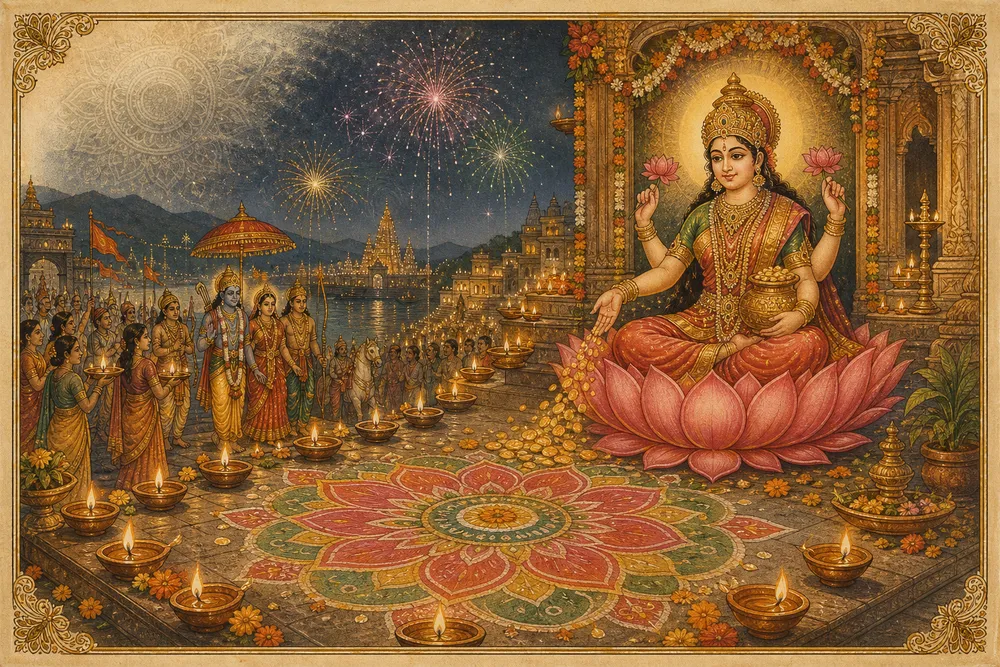
The most widespread account comes from the Ramayana: when Rama, Sita, and Lakshmana returned to Ayodhya after fourteen years of exile and the death of Ravana, the citizens met them on that moonless night with rows of ghee lamps at every door, and the next day Rama was crowned. A second tradition belongs to Lakshmi — she rose from the churning of the ocean on this very date and chose Vishnu, and so the night is given to her worship. In the south it is the day Krishna killed Narakasura, kept as Narak Chaturdashi with the ritual dawn bath.
Why it is celebrated
Diwali’s core prayer is “tamaso ma jyotirgamaya” — lead me from darkness into light. The darkness meant is ignorance, fear, and ill will; the lamp is knowledge, hope, and goodwill. Cleaning, whitewashing, and letting go of what is old are an outer purification standing for an inner one, for Lakshmi enters only a house that is clean and calm. Merchants open new account books, farmers give thanks for the harvest, and families renew the year with forgiveness and sweets. The custom of setting one lamp outside the door says that light is never only for oneself.
The katha
The story of Ayodhya is Diwali’s heart. To keep his father’s word Rama gave up the kingdom and spent fourteen years in the forest; Sita was taken, a war was fought across the sea, and Ravana fell. On the day of their return Bharata had the whole city made ready, and in the deep dark of the new moon Ayodhya’s lanes blazed with clay lamps as though the stars had come down to earth. It is said that no hearth was lit that day before a lamp was. In the Lakshmi Puja account, the churning of the ocean yielded jewels, the wish-cow, the wish-tree, and at last Lakshmi seated on a lotus; gods and asuras alike desired her, and she chose Vishnu — a sign that fortune settles where dharma is.
Stories & episodes
Five days carry five stories. On Dhanteras, Dhanvantari rose from the churning ocean holding the pot of nectar, and so it is a day for health and for buying metal. On Narak Chaturdashi Krishna killed Narakasura and freed sixteen thousand captive women — kept as the little Diwali with its oil bath before dawn. The new-moon night belongs to Lakshmi and Ganesha, and in Bengal to Kali. Govardhan Puja or Annakut recalls Krishna lifting the hill to shelter the people of Braj from Indra’s pride. The fifth day is Bhai Dooj. The festival is also remembered as the yearly return of King Bali granted by the Vamana avatar, as the nirvana of Mahavira, and as the Bandi Chhor day of Guru Hargobind, while in Gujarat the Vikram Samvat new year begins the day after.
Rituals & customs
Cleaning the house and setting rangoli and a door garland; metal bought and Dhanvantari honoured on Dhanteras; the oil bath before dawn; on the new-moon evening the worship of Lakshmi, Ganesha, and Kubera with the account books and a reading of the Shri Sukta; rows of clay lamps and a lamp raised on a pole; sweets, savouries, and gifts exchanged; the annakut offering and worship of cattle on Govardhan Puja.
Where it is celebrated
All of India, Nepal, and Indian communities worldwide — the Deepotsav at Ayodhya, Dev Deepavali at Varanasi, Kali Puja in Bengal, Narak Chaturdashi in the south, and Tihar in Nepal.