
About
गुरुर्ब्रह्मा गुरुर्विष्णुः गुरुर्देवो महेश्वरः
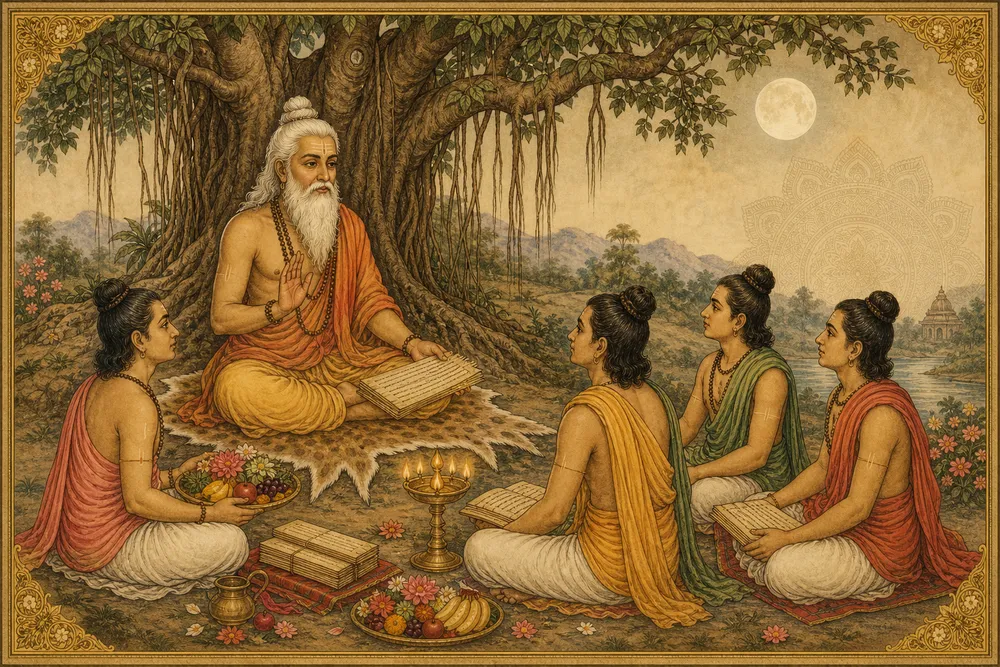
Guru Purnima is the day a student turns to acknowledge the teacher. It is also called Vyasa Purnima, for it marks the birth of Veda Vyasa, who arranged the Vedas and composed the Mahabharata.
Origin
Tradition holds that on this full moon Shiva gave the first teaching of yoga to the seven sages and so became Adi Guru, the first teacher, in the form of Dakshinamurti. Another strand keeps it as Vyasa’s birthday; son of Parashara and Satyavati, he divided the single Veda into Rig, Yajur, Sama, and Atharva, composed the eighteen Puranas, and dictated the Mahabharata to Ganesha — and so was named Veda Vyasa. In the Buddhist tradition the Buddha gave his first sermon at Sarnath on this day, and in the Jain tradition Mahavira accepted his first disciple.
Why it is celebrated
The word guru means one who removes darkness — gu, darkness, and ru, its dispelling. In the Sanatan view knowledge passes not through books but through a living lineage, and so the guru is held equal to Brahma, Vishnu, and Mahesha. The choice of Ashadha Purnima has its own logic: the rains follow, when monks and ascetics settle in one place for the four-month chaturmas of study, teaching, and practice. The festival is thus the doorway to the season of learning.
The katha
Vyasa’s own story is uncommon. Born to Satyavati and the sage Parashara on an island in the Yamuna, he was called Krishna Dvaipayana and came into the world already wise. Foreseeing that memory and lifespan would shrink in the Kali age, he divided one vast Veda into four and entrusted the parts to four disciples — Paila, Vaishampayana, Jaimini, and Sumantu — so that the knowledge would survive. Composing the Mahabharata, he needed a scribe who could match his speed; Ganesha agreed on the condition that the dictation never pause, and Vyasa countered that Ganesha write nothing without understanding it — which is why knotted, difficult verses appear throughout. His disciples honoured him on this full moon, and that observance became Guru Purnima.
Stories & episodes
Stories of teacher and student are retold on this day. Ekalavya learned archery on his own before a clay image of Dronacharya and gave up his thumb when the guru asked — devotion at its furthest edge. Aruni, son of Uddalaka, lay down in a broken embankment himself to hold back the water from a field, and his teacher renamed him for it. Krishna and Balarama gathered firewood at Sandipani’s ashram, showing that even God is a student before a teacher. Dattatreya counted twenty-four gurus, among them the earth, the wind, a bee, and a courtesan — teaching that whoever teaches you is your guru. The lineages of Kabir, Nanak, and Ramakrishna hold the day in the same regard.
Rituals & customs
Offering flowers, fruit, and cloth at the teacher’s feet and receiving a blessing; Vyasa puja and recitation of the Guru Gita; remembering the lineage and receiving initiation; taking the vow of chaturmas; satsang and the giving of food at ashrams.
Where it is celebrated
All of India and Nepal — in ashrams, monasteries, music gharanas, and schools; kept in the Buddhist tradition as Asalha Puja or Dhamma Chakka Pavattana day.