
About
ॐ हं हनुमते नमः
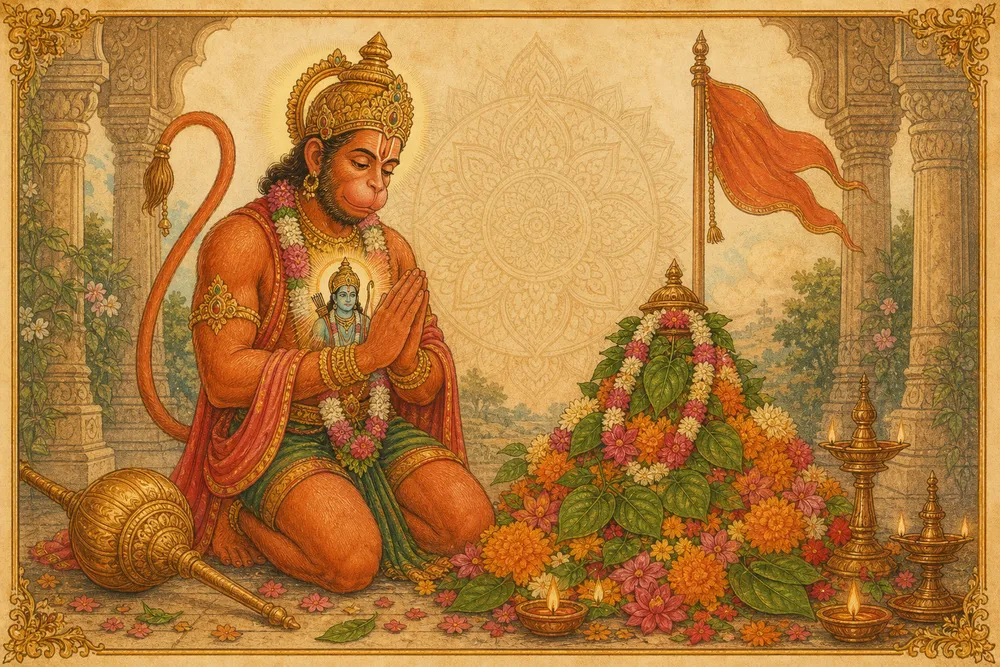
Hanuman Jayanti celebrates the birth of Hanuman, son of Anjana and Kesari and child of the wind. Across the north it falls on Chaitra Purnima, and the day recalls strength joined to humility and devotion joined to service.
Origin
Hanuman’s life is told at length in the Kishkindha, Sundara, and Yuddha Kandas of Valmiki’s Ramayana, while the Shiva Purana calls him a portion of Shiva, the eleventh Rudra. Tulsidas’s Hanuman Chalisa carried this devotion into every household. Traditions of his birthplace differ: Maharashtra points to Mount Anjaneri near Nashik and Karnataka to Anjanadri in Kishkindha, and in Tamil Nadu and Kerala the festival is kept in Margashirsha or Dhanu instead.
Why it is celebrated
Hanuman is worshipped because he is a rare union of power and character. Though his strength is limitless he asks nothing for himself; all of it is spent on Rama’s work. Devotees know him as Sankatmochan, remover of trouble, and call on him against fear, sloth, and self-doubt. Tuesdays and Saturdays are his days, and reciting the Chalisa is the most widespread practice for courage. His life teaches that strength has meaning only in service.
The katha
The apsara Punjikasthala, under a curse, was born as the vanara Anjana and became Kesari’s wife. Longing for a child, she worshipped Shiva for years. In that same time Dasharatha performed his putrakameshti yajna at Ayodhya, and Vayu carried a portion of that divine kheer on the wind to the hands of Anjana at her austerities. From receiving it Hanuman was born on Chaitra Purnima — a portion of Shiva, a son of the wind, and the future servant of Rama. As a hungry child he flew up to swallow the rising sun, mistaking it for fruit; Indra struck him with the vajra, breaking his jaw and leaving him senseless, and from that hanu, the jaw, came his name. Enraged, Vayu withheld the breath of all creation, and the gods led by Brahma revived the child and blessed him with immunity to weapons, boundless strength, and the power to change form at will.
Stories & episodes
Hanuman’s stories are of capacity born from devotion. Finding Sita in Lanka and handing her Rama’s ring in the Ashoka grove; recognising his own forgotten strength when Jambavan reminded him of it; carrying the whole of Mount Dronagiri with its healing herb to save Lakshmana in battle; tucking the sun under his arm to hold back the dawn; taking the five-faced form to slay Ahiravana — and breaking apart a pearl necklace Sita gave him, asking what worth a thing has if Rama’s name is not within it. The old monkey whose tail Bhima could not lift, teaching him about pride in the Mahabharata, is the same Hanuman. He is held to be chiranjivi, still living, present in subtle form wherever the story of Rama is told.
Rituals & customs
A morning bath followed by the Hanuman Chalisa, Sundarkand, and Bajrang Baan; a chola of sindoor and jasmine oil on the image; offerings of red flowers, paan, and jaggery with gram; boondi laddoos as prasad and a community meal; flags and processions at the temple.
Where it is celebrated
All of India — Chaitra Purnima in the north, its dawn in Maharashtra, and Margashirsha in Tamil Nadu and Kerala; with great gatherings at Salasar, Mehandipur, and Hanuman Garhi.