About
ॐ नारायणाय नमः
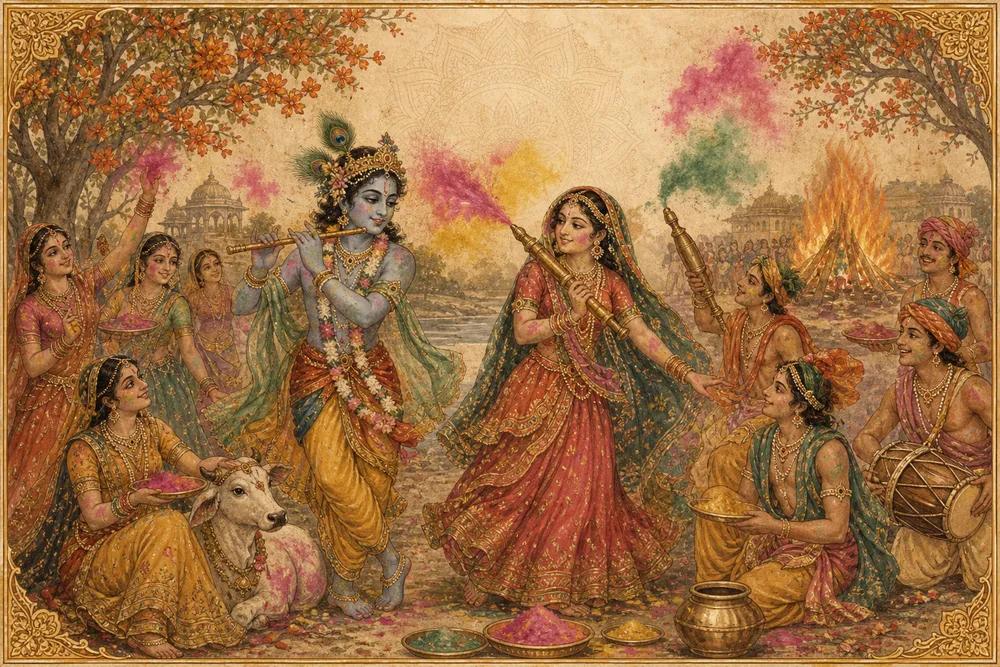
Holi unfolds over two days — the night of Holika Dahan, when a bonfire consumes what stands for ego and injustice, and the next day of Dhulandi, when every distinction is forgotten in a haze of colour.
Origin
Holi is among India’s oldest festivals. “Holaka” appears in Jaimini’s Purvamimamsa Sutras and the Kathaka Grihyasutra, and its observance is described in the Narada and Bhavishya Puranas. At root it was Vasantotsava, a spring festival marking the new harvest and the end of cold, in which fresh grain was roasted in the fire as an offering. In time the story of Prahlada and Holika attached to it, and it became the festival of devotion’s victory.
Why it is celebrated
Holi’s first meaning is the burning of inner impurity — anger, pride, envy, and division. Its second is equality; once the colour is on, high and low, rich and poor, insider and outsider all dissolve, and a year of grievances is forgiven with the words “don’t mind, it’s Holi.” It is also a festival of the turning season, its natural colours once made from palash and tesu blossom to ready the body for spring.
The katha
The asura king Hiranyakashipu, protected by a boon, believed himself to be God, yet his son Prahlada remained wholly devoted to Vishnu. The father had him poisoned, trampled by elephants, thrown among serpents, and cast from a cliff, and each time Narayana preserved him. At last Hiranyakashipu’s sister Holika, who possessed a garment that fire could not touch, took Prahlada on her lap and sat upon the pyre. As the flames rose the garment flew from her onto the boy; Holika burned and Prahlada walked out unharmed. Vishnu then appeared as Narasimha and ended Hiranyakashipu at dusk — neither day nor night, neither indoors nor out.
Stories & episodes
Braj’s Holi belongs to Krishna and Radha. At Barsana the lathmar Holi has the women of the village driving off the men of Nandgaon with staves, Vrindavan keeps a Holi of flowers, and Mathura celebrates for forty days. In the south the day is Kamadahana: when Kamadeva loosed his flower arrow at Shiva deep in meditation, Shiva opened his third eye and burned him to ash, then restored him at Rati’s grieving plea — and so cooling sandal paste is offered to Shiva. The Bhavishya Purana tells of the demoness Dhundha who tormented children, driven away by King Prithu’s people with bonfires, laughter, and noise — from which the raucous, teasing side of Holi is traced.
Rituals & customs
Wood, dung cakes, and fresh grain offered to the Holika fire with a circumambulation; gulal, abir, colour, and water on the following day; gujiya, malpua, dahi bade, and thandai; phag, chautal, and hori songs; a pinch of gulal at an elder’s feet in return for a blessing.
Where it is celebrated
All of India and Nepal — Braj’s lathmar Holi, Bengal’s Dol Purnima and Basanta Utsav, Punjab’s Hola Mohalla, Goa’s Shigmo, and Kamadahana in the south.