
About
ॐ नमः शिवाय
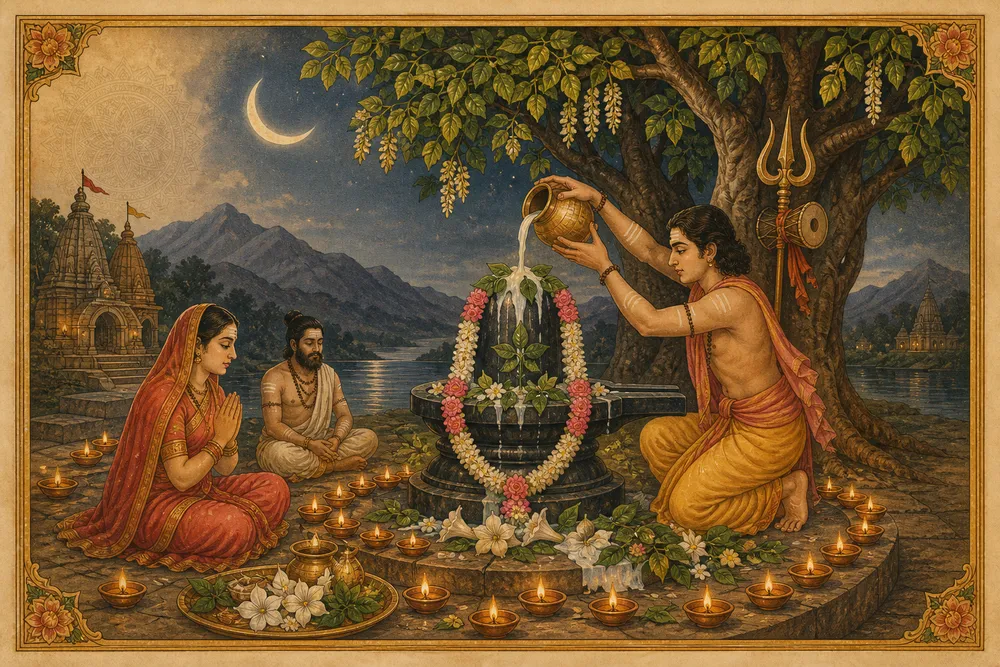
Maha Shivaratri is the one night of the year given wholly to Shiva. Devotees fast through the day and keep vigil through all four watches of the night, bathing the Shiva linga — a festival less of festivity than of wakefulness and inner stillness.
Origin
The Shiva Purana, Linga Purana, and Skanda Purana all dwell on the greatness of this night. The foremost account is the Lingodbhava — the night Shiva appeared as an endless pillar of light whose beginning and end neither Brahma nor Vishnu could find. A second tradition holds it to be the night of Shiva and Parvati’s wedding, and a third the night Shiva held the halahala poison churned from the ocean in his throat and became Neelkanth.
Why it is celebrated
The purpose of Shivaratri is not worship alone but the waking of awareness. On this night the earth’s position is said to be such that energy in a practitioner rises naturally upward, so sitting with a straight spine, staying awake, and repeating the mantra are held to be especially fruitful. Fasting lightens the body, vigil sharpens the mind, and the chant of “Om Namah Shivaya” quietens the ego. The Neelkanth story teaches that holding life’s poison in the throat, rather than passing it on, is itself compassion.
The katha
The best-loved story is of a poor hunter named Lubdhaka. Lost in the forest at nightfall, he climbed a bael tree for safety, and to keep himself from sleeping he plucked its leaves and let them drop — and below, by chance, stood a Shiva linga. Without knowing it he offered bael leaves through all four watches, ate nothing all day, and stayed awake till dawn. Pleased by this unwitting fast, bathing, and vigil, Shiva appeared and granted him liberation. The story’s point is that Shiva looks at the heart, not the procedure.
Stories & episodes
In the Lingodbhava story, Brahma and Vishnu were locked in a quarrel over supremacy when a limitless pillar of fire rose between them. Vishnu went down and Brahma up to find its ends; Vishnu admitted defeat humbly, Brahma lied and was cursed — and Shiva revealed that the formless alone is true. On the night of the churning, the gods kept the poison-bearing Shiva from sleep with dance and praise, and from this the tradition of vigil grew. In memory of the wedding, Shiva’s marriage procession is carried through Ujjain, Varanasi, and many temple towns, while the twelve Jyotirlingas are bathed through the night.
Rituals & customs
A day-long fast, without water or on fruit alone; bathing the linga with water, milk, curd, ghee, honey, and sugar; offerings of bael leaves, dhatura, bhang, and white flowers; Rudrabhishek and recitation of the Mahamrityunjaya and Shiva Tandava Stotra; worship in four watches and vigil till dawn.
Where it is celebrated
All of India and Nepal — with great gatherings at Kashi Vishwanath, Ujjain Mahakal, Somnath, Kedarnath, and Pashupatinath.