Winter · 14 January 2026
Makar Sankranti
मकरसंक्रान्तिः · The sun turns northward
Festival details
14 January 2026
Magha · Makar Sankranti
1 day
Pongal in Tamil Nadu; Lohri a day earlier in Punjab.
About
ॐ सूर्याय नमः
Makar Sankranti marks the day the sun moves from Sagittarius into Capricorn and begins Uttarayana, its northward journey. It is the one major Hindu festival fixed by the solar calendar, which is why its date barely shifts each year.
Origin
The roots of this festival lie in Vedic sun worship. The solar hymns of the Rig Veda and the Gayatri mantra address Surya as the source of life, light, and consciousness. Sankranti means the sun crossing from one zodiac sign into the next; twelve occur each year, but Makar Sankranti is held holiest because from this day the days lengthen and Uttarayana — called devayana, the path of the gods, in the scriptures — begins.
Why it is celebrated
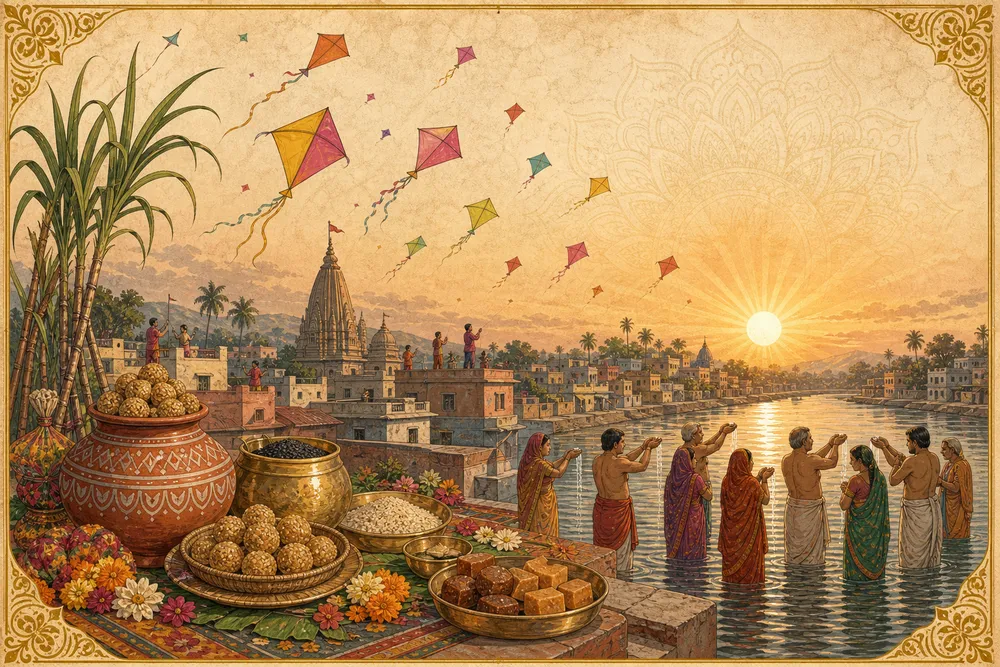
The day is a celebration of gratitude and turning points. Farmers offer the first share of the new harvest to the sun. Eating sesame and jaggery warms the body through winter, and sayings like “take this til-gud and speak sweetly” carry the message of letting go of bitterness. Bathing in holy rivers, giving in charity, and offering water to the sun are the three central acts of the day.
The katha
A well-known Puranic account tells of the estrangement between Surya and his son Shani, born of Surya’s slight toward Shani’s mother Chhaya. Capricorn, Makara, is Shani’s own house. When the sun enters Makara he is visiting his son’s home — a reconciliation of father and son and the end of an old bitterness. For this reason the day is kept for mending relationships, asking forgiveness, and sharing sweets.
Stories & episodes
A second story is that of Bhagiratha, who through fierce austerity brought the Ganga down to earth to liberate his ancestors, the sixty thousand sons of King Sagara; the river met the sea on Makar Sankranti, remembered today in the Gangasagar fair. In the Mahabharata, Bhishma lay on his bed of arrows waiting for Uttarayana and gave up his body on this very day, since leaving the body during the sun’s northward course is said to grant a higher passage. Across India the same festival appears as Pongal, Magh Bihu, Uttarayan, and Lohri, and in Gujarat the sky fills with kites.
Rituals & customs
Bathing in the Ganga, Yamuna, Godavari, or at a sangam; offering water to the sun and reciting the Aditya Hridaya Stotra; sesame-jaggery laddoos, gajak, and khichdi; giving sesame, clothes, grain, and cattle in charity; kite flying.
Where it is celebrated
All of India — Khichdi in the north, Pongal in Tamil Nadu, Magh Bihu in Assam, Uttarayan in Gujarat, and Lohri in Punjab a day earlier.