About
ॐ ऐं ह्रीं क्लीं चामुण्डायै विच्चे
Navratri is nine nights given to the nine forms of the Goddess. Each day honours one of the Navadurga, and the tenth is kept as Vijayadashami, the victory of truth over falsehood.
Origin
The scriptural ground of Navratri is the Devi Mahatmya or Durga Saptashati within the Markandeya Purana, which recounts the Goddess’s three cycles and the slaying of Mahishasura, Shumbha and Nishumbha, and Raktabija. Four Navratris fall in a year — Chaitra, Ashwin, and two hidden ones — but the autumn Sharadiya is the best known. It is held that Rama invoked the Goddess out of season before his war with Ravana, an act called Akal Bodhan, and from then this autumn worship took hold.
Why it is celebrated
Navratri rests on the understanding that the primal energy of the cosmos is Shakti, and that she both protects and destroys. Nine days of fasting, restraint, and vigil are a practice for thinning the inertia within — the first three as Durga to destroy impurity, the next three as Lakshmi to grow virtue, and the last three as Saraswati to gain knowledge. The worship of young girls on Ashtami or Navami puts into practice the belief that the Goddess dwells in every woman. It is also a seasonal joint, when fasting cleanses the body.
The katha
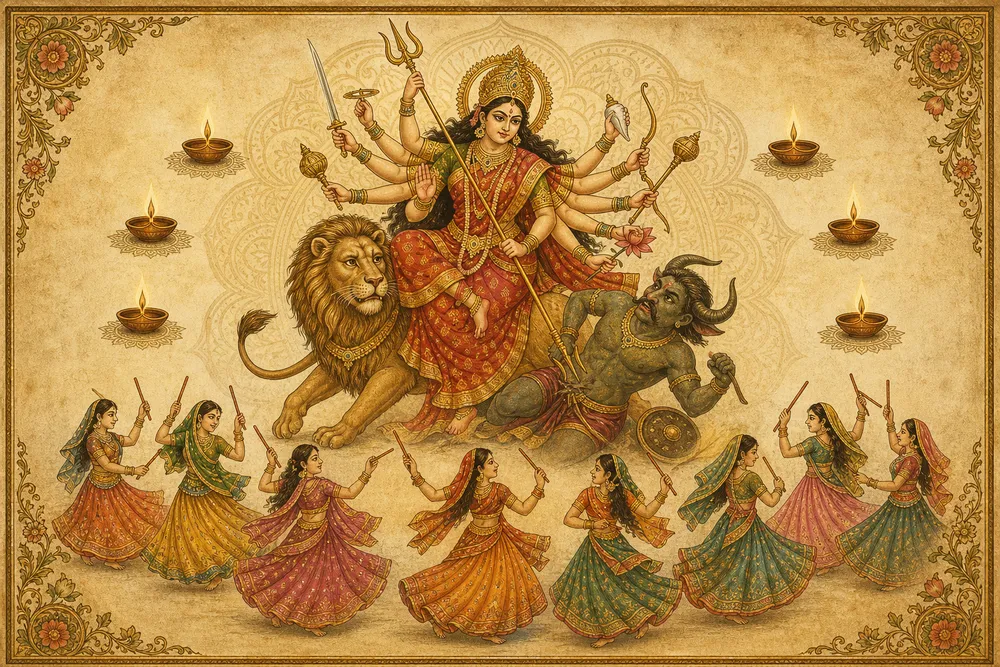
Mahishasura had won from Brahma the boon that no god or man could kill him. He seized the heavens and drove the gods into exile. Then the radiance of Brahma, Vishnu, Shiva, and all the rest gathered together, and from it rose Durga, many-armed, mounted on a lion, armed by each god with his own weapon. The battle raged nine days as Mahishasura shifted shape again and again — lion, elephant, man, and at last buffalo. On the tenth day the Goddess pierced his head with her trident and became Mahishasuramardini. The story says that where one power alone will not suffice, only gathered strength ends injustice.
Stories & episodes
The Durga Saptashati tells of Shumbha and Nishumbha, whose general Raktabija multiplied from every drop of his blood that touched the ground; the Goddess took the form of Kali and drank his blood before it fell — that is, pride must be stopped at its source. The nine names of the Navadurga — Shailaputri, Brahmacharini, Chandraghanta, Kushmanda, Skandamata, Katyayani, Kalaratri, Mahagauri, and Siddhidatri — are read as nine rungs of practice. From Sati’s death and Shiva’s grief-stricken dance comes the tradition of the fifty-one Shakti Peethas, where great fairs gather during these nights. In Gujarat garba and dandiya circle the Goddess as life circles its source, in Bengal Durga Puja welcomes her home to her parents, and in the north the nine days pass with the staging of the Ramlila.
Rituals & customs
Installing the kalash and a lamp kept burning nine days; sowing barley and watering it each morning; a fruit or sattvic fast; readings of the Durga Saptashati, Durga Chalisa, and Lalita Sahasranama; one form worshipped each day with its colour worn; kanya pujan, havan, and prasad of puri, chana, and halwa on Ashtami and Navami; garba, dandiya, and the Durga Puja pandals.
Where it is celebrated
All of India — Durga Puja in Bengal, Assam, and Odisha; garba in Gujarat; fasting and Ramlila in the north; Bommai Golu and the Mysore Dasara in Karnataka and Tamil Nadu.