
About
श्री राम जय राम जय जय राम
Ram Navami marks the birth of Rama, the seventh avatar of Vishnu, born at midday in Ayodhya to King Dasharatha and Queen Kausalya on Chaitra Shukla Navami. The day falls on the ninth and final day of Chaitra Navratri.
Origin
The festival rests on the Bala Kanda of Valmiki’s Ramayana, which describes Rama’s birth at length. Tulsidas began writing the Ramcharitmanas at Ayodhya on Ram Navami in Samvat 1631, which deepened the day’s importance across the north. Texts such as the Agastya Samhita prescribe the Ram Navami vrat, and the festival has long been kept with special care at Ayodhya, Chitrakoot, Janakpur, Bhadrachalam, and Rameswaram.
Why it is celebrated
Rama is worshipped not for wonders but for conduct. As son, brother, husband, friend, and king he is the measure of rightness in every role, and so is called Maryada Purushottam. The day is a reminder that dharma means holding to one’s word, duty, and compassion even when circumstances are cruel. The vision of Ramrajya — a realm where none is sorrowful, afraid, or in want — is still invoked as the standard of good governance.
The katha
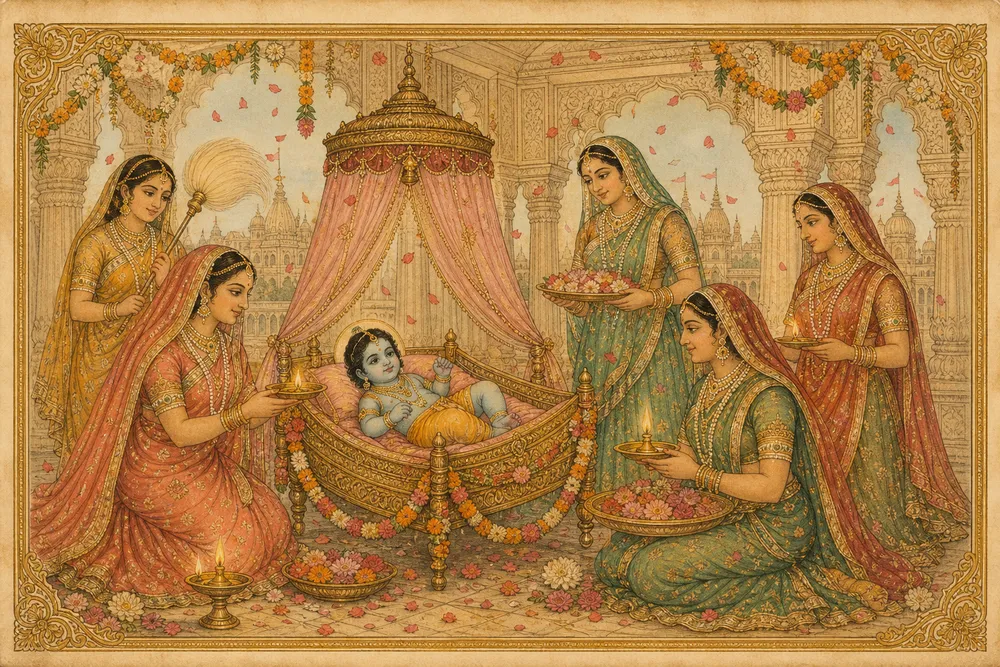
King Dasharatha of Ayodhya had no heir. On the advice of his guru Vasishtha he performed the putrakameshti yajna under the direction of the sage Rishyasringa. From the sacrificial fire a radiant being rose and handed Dasharatha a golden vessel of kheer. The king shared it among his three queens — and Rama was born to Kausalya, Bharata to Kaikeyi, and Lakshmana and Shatrughna to Sumitra. Rama was born on Chaitra Shukla Navami in the Abhijit muhurta; Ayodhya filled with rejoicing and flowers fell from the sky. The purpose of this descent was to free the earth from Ravana’s tyranny.
Stories & episodes
The episodes of Rama’s life each carry a lesson. Ahalya’s release shows that compassion outweighs a curse; the boatman Kevat, that the Lord yields to a devotee’s insistence; Shabari’s tasted berries, that feeling is the finest offering. Rama’s calm on hearing of his exile, Bharata leaving the throne empty for fourteen years, Hanuman’s leap across the sea, Jatayu giving his life, and Vibhishana choosing dharma over kin are all remembered without end. On this day Ramlila cycles and unbroken readings of the Ramayana conclude across the country, and vast crowds bathe in the Sarayu at Ayodhya.
Rituals & customs
A fast from sunrise to noon; a cradle decorated and rocked for the infant Rama; readings of the Ramcharitmanas, Sundarkand, and Ram Raksha Stotra; offerings of panchamrit, panjiri, and saffron kheer; processions with bhajans and kirtan.
Where it is celebrated
All of India — most fully at Ayodhya, Chitrakoot, Nashik, and Rameswaram; the Sita-Rama Kalyanam at Bhadrachalam in Andhra; Ramjanma kirtans in Maharashtra.