
About
ॐ यमाय नमः
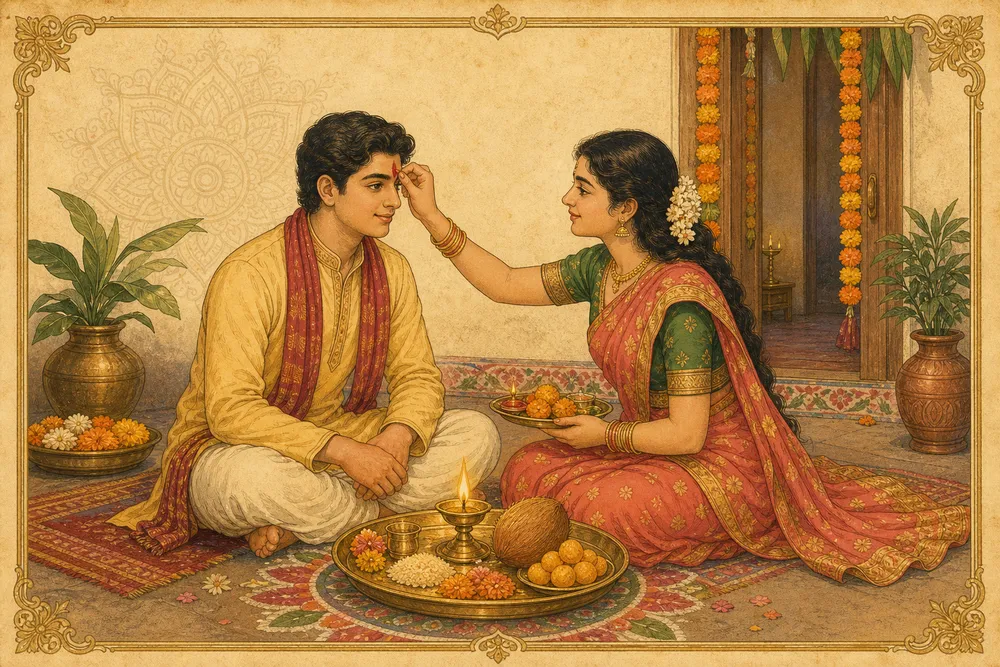
Bhai Dooj is the fifth and last day of Diwali, when a sister marks her brother’s forehead and prays for his long life, and he comes to her home to eat. Its scriptural name is Yama Dwitiya.
Origin
The festival’s root is the story of Yama and his sister Yamuna, recorded in the Puranas as Yama Dwitiya. Yami, that is Yamuna, invited her brother the god of death again and again, and he came on Kartika Shukla Dwitiya. In memory of that visit the date became the day a brother goes to his sister’s house. This is what sets it apart from Raksha Bandhan, where the sister comes to the brother; here the brother comes to her courtyard.
Why it is celebrated
Bhai Dooj says that a bond is kept by making the journey. The sister’s tilak is more than a good wish; it recalls Yama’s boon, for a brother who receives it from her hand on this day is held free of untimely death and of Yama’s torment. In giving what gifts he can, the brother acknowledges that her dignity is his charge. Bathing in the Yamuna is also prescribed today, since she holds the boon that whoever bathes in her is freed from the fear of Yama.
The katha
Yamuna loved her brother Yama dearly and longed for him to come and eat at her house, but the god of death could never take leave of his work. After many invitations he arrived at her door on Kartika Shukla Dwitiya. Yamuna bathed, decorated the threshold, marked his forehead, waved the lamp before him, and fed him with her own hands. So pleased was Yama that he asked her to name a boon. Wanting nothing for herself, she asked that he come to her house on this day every year, and that any brother who receives his sister’s tilak and food on this day be spared Yama’s torment. He granted it, and since then the date has been called Yama Dwitiya.
Stories & episodes
A second story belongs to Krishna. After killing Narakasura he went to his sister Subhadra, who welcomed him with a lamp and flowers, marked his forehead, fed him sweets, and blessed his victory — this too is taken as a ground for the festival. In some regions the day is kept alongside Chitragupta Puja, when the Kayastha community honours the pen and inkpot. Its names differ across the country: Bhaubeej in Maharashtra and Goa, Bhai Phonta in Bengal, Bhai Tika in Nepal, and Bhaiya Dooj in the north. In Bengal the sister marks her brother with sandal, kajal, and curd, and only then breaks her own fast.
Rituals & customs
The sister drawing a square on the floor and seating her brother there; a tilak of roli, rice, and sandal with the waving of the lamp; a coconut or betel nut placed in his hands; his favourite meal and sweets; his gift and his promise of protection; a bath in the Yamuna and worship of Yama and Chitragupta.
Where it is celebrated
All of India and Nepal — Bhaiya Dooj in the north, Bhaubeej in Maharashtra, Bhai Phonta in Bengal, Godhan and Chitragupta Puja in Bihar, and Bhai Tika in Nepal.