
About
ॐ रामाय नमः
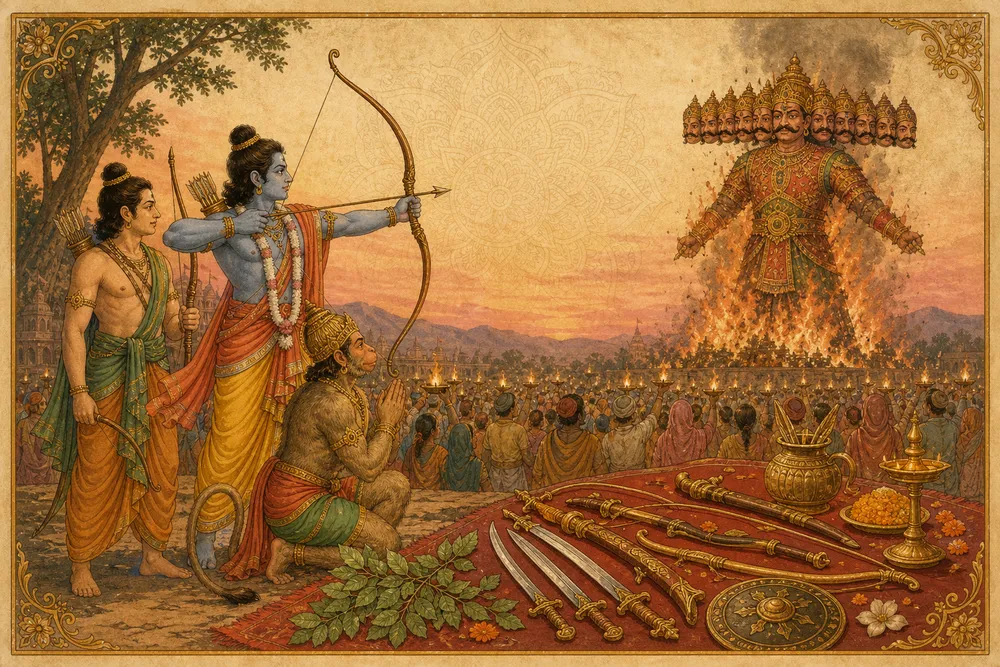
Vijayadashami is the tenth day after Navratri, when Rama killed Ravana and Durga killed Mahishasura. At dusk the effigies of Ravana, Kumbhakarna, and Meghnad go up in flame.
Origin
Two parallel traditions meet in this festival. In the north it belongs to the war book of the Ramayana: after nine days of invoking the Goddess, Rama killed Ravana of Lanka on the tenth. In the east it is Durga’s victory over Mahishasura, which is why her images are immersed on this day. A third strand comes from the Mahabharata: at the end of their concealment the Pandavas took back the weapons hidden in the shami tree on this day, and Arjuna won the battle of Virata — for which reason it is held the finest hour for honouring one’s tools and beginning anything new.
Why it is celebrated
Dussehra means the taking away of ten faults. The effigy of Ravana stands not outside but within — for pride, desire, anger, greed, attachment, arrogance, envy, sloth, cruelty, and injustice — which is why it must be burned every year, since these return every year. The day says that Ravana, for all his learning, austerity, and devotion to Shiva, was undone by one flaw alone. The very name Vijayadashami says the victory is dharma’s and not strength’s, and that whatever is begun in this undefeated hour will succeed.
The katha
During the fourteen years of exile Ravana carried Sita away to Lanka. Rama made an ally of Sugriva, Hanuman crossed the sea and found her, and Nala and Nila built the causeway. Ten days of terrible fighting took Meghnad, Kumbhakarna, and all of Ravana’s champions. Ravana held a boon that no ordinary weapon could kill him, and a pool of nectar lay in his navel — a secret revealed to Rama by his own righteous brother Vibhishana. On Ashwin Shukla Dashami Rama pierced that navel with the Brahmastra and Ravana fell. Even dying he gave Lakshmana counsel on statecraft, and Rama had his last rites performed with full honour, showing that even an enemy’s virtue deserves respect.
Stories & episodes
Ravana’s story is also a warning: master of the Vedas, author of the Shiva Tandava Stotra, an ascetic without equal, and yet pride made all his austerity worthless. Kumbhakarna stood by his brother knowing the cause was wrong, and Vibhishana left his brother to stand by dharma — two ends of the same loyalty. In Maharashtra shami and apta leaves are exchanged on this day as “gold,” across Rajasthan and the north weapons are honoured and new vehicles and ventures begun, and in Karnataka the Mysore Dasara procession fills the streets. Kullu’s Dussehra starts on Dashami and runs a week, gathering the palanquins of hundreds of local deities; Bastar’s lasts seventy-five days. In Bengal the Goddess is sent home this day with sindoor khela.
Rituals & customs
Honouring weapons, vehicles, and the tools of one’s trade; exchanging shami and apta leaves; beginning new work, studies, or a new home; the close of the Ramlila and the burning of Ravana; jalebi, fafda, and jaggery sweets; the immersion of the Goddess.
Where it is celebrated
All of India — Ravana burning in the north, the Dasara of Mysore and Kullu, the exchange of “gold” leaves in Maharashtra, and Vijaya Dashami with sindoor khela in Bengal.