Monsoon · 3 September 2026
Krishna Janmashtami
कृष्णजन्माष्टमी · Compassion born at midnight
About
ॐ नमो भगवते वासुदेवाय
Janmashtami celebrates the birth of Krishna, the eighth avatar of Vishnu, born at midnight in a Mathura prison under the shadow of Kansa’s fear. Devotees fast and keep vigil until the hour of his birth, greeting it with conches, bells, and kirtan.
Origin
The account of Krishna’s birth is told at length in the tenth book of the Bhagavata Purana and in the Harivamsa and Vishnu Puranas. The conjunction of Bhadrapada Krishna Ashtami with the Rohini nakshatra is taken as the canonical hour, which is why the nishitha, the deep midnight, decides how the fast is reckoned. Mathura, Vrindavan, Gokul, Nandgaon, and Dwarka are the festival’s centres, and the swing and tableau traditions in northern temples are centuries old.
Why it is celebrated
The heart of Janmashtami is the Gita’s promise that when dharma weakens and wrongdoing grows, the divine itself descends. Krishna was born in a prison, which says that light arrives in the thickest dark. As a child he is the butter thief, as a youth the centre of love and the raas, and at Kurukshetra the teacher of the Gita — a path to the divine through every mood of life. The vigil till midnight is practice in waiting and staying awake within.
The katha
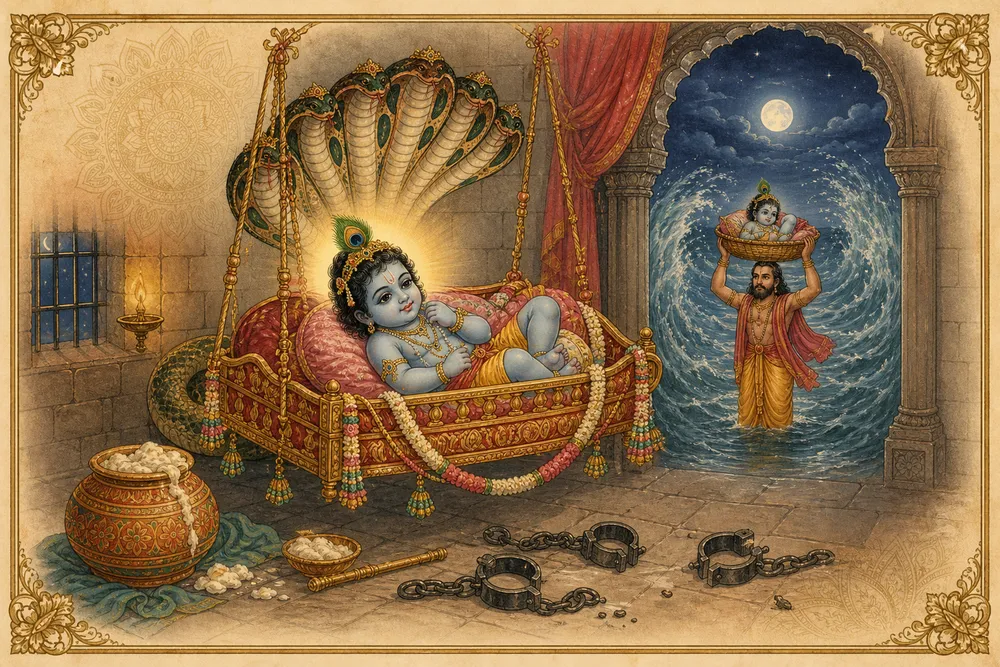
Kansa, the tyrant of Mathura, learned from a voice in the sky that the eighth child of his sister Devaki would be his death. He imprisoned Devaki and Vasudeva and killed each child as it came. At midnight on Bhadrapada Krishna Ashtami, under the Rohini star, the eighth was born. In that instant the guards sank into sleep, the shackles fell open, and the doors stood unbarred. Vasudeva carried the infant to the swollen Yamuna; the river parted and Sheshanaga spread his hoods against the rain. At Gokul he left Krishna with Nanda and Yashoda and carried their newborn daughter — Yogamaya — back to the cell. When Kansa tried to dash her against the stone she rose into the sky in her divine form and told him his death was already safe elsewhere.
Stories & episodes
The play at Gokul and Vrindavan has no end. The killing of Putana, the breaking of the cart, the stealing of butter, and Yashoda glimpsing the universe in his mouth; the subduing of the serpent Kaliya; the lifting of Govardhan to shield Braj from Indra’s wrath; the raas of the gopis drawn by his flute and Radha’s undivided love; the death of Kansa and the freeing of his parents. Later he is a king in Dwarka, Arjuna’s charioteer in the Mahabharata, and the teacher of the Gita at Kurukshetra, laying out the paths of action, knowledge, and devotion. Sudama’s handful of rice and the plain meal at Vidura’s house show that he cares for love and not for splendour. The next day, Nandotsav, the dahi handi is broken in memory of the cowherd boys’ mischief.
Rituals & customs
A day-long fast broken at midnight; the infant Krishna bathed in panchamrit and Ganga water, then dressed in new clothes, a crown, and a flute; a decorated swing and tableaux; offerings of butter and mishri, dhaniya panjiri, panchamrit, and the chhappan bhog; readings from the tenth book of the Bhagavata, kirtan, and raas lila; the dahi handi the following day.
Where it is celebrated
All of India — grandest at Mathura, Vrindavan, Gokul, and Dwarka; dahi handi in Maharashtra; the Dwarka festival in Gujarat; Gokulashtami in Manipur, Odisha, and the south.