
About
येन बद्धो बली राजा दानवेन्द्रो महाबलः
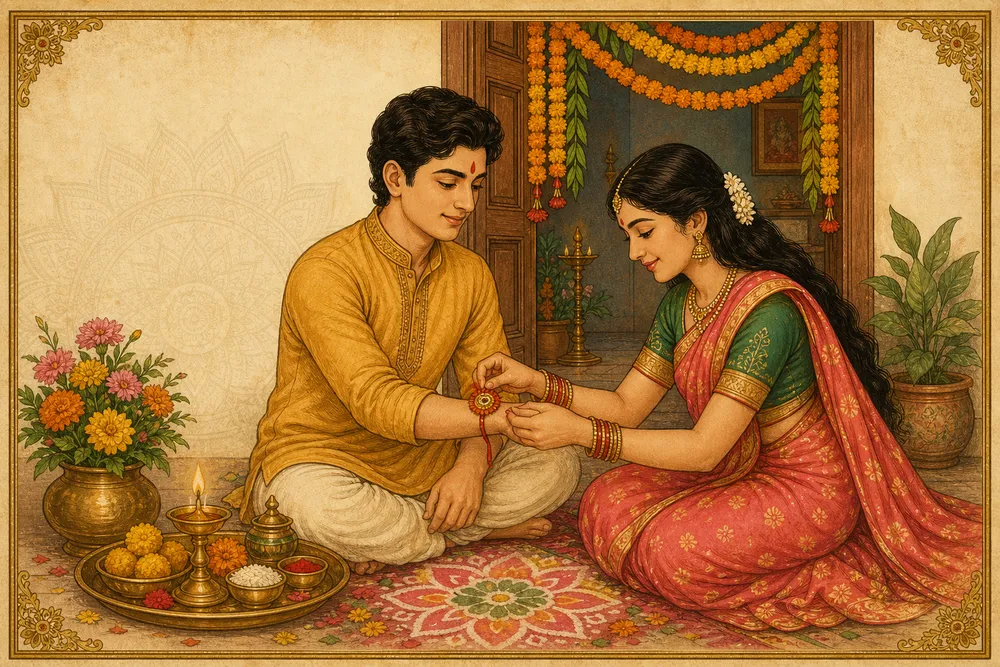
On Raksha Bandhan a sister ties a raksha sutra on her brother’s wrist and he pledges to protect her. The thread is not merely thread but a bond of affection and responsibility.
Origin
The raksha sutra is Vedic in origin. On Shravana Purnima brahmins change the sacred thread and perform the Shravani upakarma, and the priest ties a protective thread on the patron’s wrist with a mantra. The Bhavishya Purana tells of Indra: before his war with Vritra, on Brihaspati’s instruction, Indrani Shachi tied a consecrated thread on his wrist and he prevailed. What began as a thread of invoked protection grew, in time, into the festival of a brother and sister’s affection.
Why it is celebrated
The festival’s sense is that asking for protection is no weakness and giving it is no privilege but a duty. The thread a sister ties reminds her brother that his strength is meant to guard someone’s dignity. The bond is not confined to birth — threads are tied to soldiers, to trees, to rivers, and to neighbours. The choice of Shravana Purnima has its reason too: with the rains ending, farming and journeys began, and the thread was a way of sending someone off with good wishes.
The katha
The most beloved account is from the Mahabharata. When Shishupala was slain, Krishna’s finger was cut and began to bleed. Draupadi tore the border of her sari without a moment’s thought and bound the wound. Krishna took that tenderness as a debt and promised to protect her — and when she was disrobed in the Kaurava court, that same strip of cloth became endless fabric and guarded her honour. A second story belongs to the Vamana avatar: when Vishnu as Vamana asked King Bali for three paces of land and sent him to the netherworld, then stayed with him to keep his word, Lakshmi came as an ordinary woman, tied a rakhi on Bali’s wrist, and claimed her husband as her gift from a brother.
Stories & episodes
In the story of Yamuna and Yama a sister’s love wins the gift of immortality, remembered again at Bhai Dooj. The tale of Santoshi Mata turns on a sister’s faith and a brother’s help. In history, Rani Karnavati of Mewar sent a rakhi to Humayun asking for aid, and Alexander’s wife sent a thread to Puru begging for her husband’s life — and on the field Puru stayed his raised hand. In 1905, protesting the partition of Bengal, Rabindranath Tagore called on Hindus and Muslims to tie rakhis on one another, making the thread a sign of unity as well. Along the coast and in Maharashtra the same day is Narali Purnima, when fishermen offer coconuts to the sea.
Rituals & customs
A tray with the rakhi, roli, rice grains, a lamp, and sweets; a tilak, aarti, and the tying of the thread; the brother’s gift and his promise; kheer, ghevar, and coconut dishes at home; the changing of the sacred thread and Shravani upakarma among brahmins.
Where it is celebrated
All of India and Nepal — most prominent in the north and west; Narali Purnima in Maharashtra and Goa; Avani Avittam or Upakarma in the south; Janai Purnima in Nepal.